Leave Your Message
Choosing among the 7 Best Supply Centrifugal Fan Suppliers Worldwide requires more than comparing catalog prices. Industrial buyers need dependable airflow, stable pressure, efficient motors, and clear technical support. This guide examines suppliers through practical purchasing criteria, including product range, manufacturing experience, testing procedures, delivery capability, and after-sales service. Each supplier should provide readable performance curves, operating limits, material details, and maintenance guidance. Small details matter. A poorly matched fan can create vibration, excessive noise, or unnecessary energy costs.
The evaluation also considers application experience across factories, warehouses, ventilation systems, and process equipment. Experienced suppliers usually explain how impeller design, casing structure, motor selection, and inlet conditions affect performance. Reliable documentation is equally important. Certifications, inspection records, warranty terms, and replacement-part availability can reveal operational maturity. However, “best” remains partly subjective. A supplier serving a large chemical plant may not suit a small workshop with limited space. Market data and delivery conditions can also change. Some brochures still emphasize maximum airflow without explaining pressure loss. That deserves careful questioning. Buyers should verify actual operating points, local service coverage, and installation requirements before ordering. This overview aims to support informed comparisons, not replace professional engineering review. The right Supply Centrifugal Fan partner should offer measurable performance, honest communication, and consistent support throughout the equipment’s working life. Reliability is proven after installation.
Understanding Supply Centrifugal Fans and Their Industrial Applications
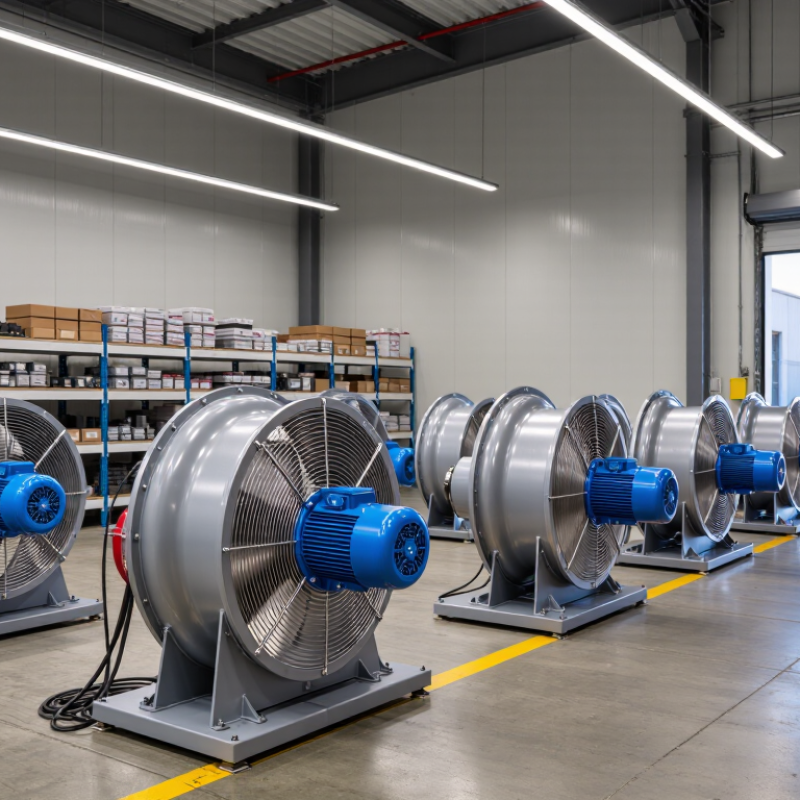
Supply centrifugal fans move air by accelerating it outward through rotating impellers. They support ventilation, combustion air, drying, filtration, and process cooling. Their pressure-building ability suits factories with long ducts, filters, dampers, and heat exchangers. In a working plant, airflow is not abstract. It reaches a furnace, passes across wet material, or removes heat above a production line.
The International Energy Agency reports that electric motor systems consume roughly half of global electricity. Fan motors are only one part of that demand, yet poor control can waste substantial energy. U.S. Department of Energy fan-system guidance highlights pressure reduction, efficient control, and correct sizing as key improvement areas. Variable-speed drives often reduce power sharply when demand changes. Small details matter. A blocked filter increases resistance, while an oversized impeller can create needless airflow and noise.
Selection should begin with measured airflow, static pressure, temperature, dust loading, and operating hours. Materials and sealing also require attention in humid or corrosive environments. I have seen specifications focus heavily on peak airflow while ignoring part-load performance. That approach looks safe, but it may raise electricity costs and shorten bearing life. Field testing, vibration checks, and periodic filter inspection make the installation more dependable. Still, every facility differs, and published efficiency figures may not represent actual site conditions.
| Supplier Capability Profile | Typical Airflow Range | Typical Static Pressure | Typical Air Temperature | Common Fan Configuration | Industrial Applications | Important Supplier Documents | Best Selection Criterion |
|---|---|---|---|---|---|---|---|
| 1. General Industrial Ventilation Supplier | 1,000–80,000 m³/h | 500–3,000 Pa | −20°C to 80°C | Backward-curved or forward-curved impeller; direct-drive or belt-drive | Factory ventilation, warehouses, workshops, commercial buildings, and air-handling units | Fan curve, dimensional drawing, motor data sheet, noise data, and balancing record | Stable airflow, low operating noise, energy efficiency, and easy maintenance |
| 2. Process Exhaust Fan Supplier | 2,000–120,000 m³/h | 1,000–6,000 Pa | −20°C to 250°C | Heavy-duty backward-inclined or radial-blade design; belt-drive commonly used | Chemical processing, metalworking, welding fumes, kiln exhaust, and production lines | Material specification, temperature rating, shaft-seal details, vibration limits, and performance test report | Material compatibility, continuous-duty reliability, and resistance to process contaminants |
| 3. Dust-Collection Fan Supplier | 3,000–150,000 m³/h | 2,000–8,000 Pa | Up to approximately 200°C, depending on construction | Radial-blade or high-pressure backward-curved impeller with abrasion-resistant lining options | Woodworking, cement, grain handling, foundries, mineral processing, and material conveying | Wear-material specification, particle-loading assumptions, pressure-loss calculation, and service schedule | Abrasion resistance, ability to handle dust loading, impeller balance, and accessible wear parts |
| 4. High-Temperature Fan Supplier | 2,000–100,000 m³/h | 1,000–5,000 Pa | 250°C–600°C with application-specific cooling arrangements | Heat-resistant impeller, extended shaft, bearing pedestal, and optional air-cooled or water-cooled bearing system | Ovens, furnaces, heat-treatment lines, thermal processing, and hot-gas circulation | Temperature profile, metallurgy certificate, thermal expansion calculation, bearing arrangement, and test conditions | Verified operating temperature, heat-resistant materials, shaft alignment, and bearing life |
| 5. Corrosion-Resistant Fan Supplier | 500–60,000 m³/h | 500–4,000 Pa | −10°C to 120°C, depending on lining and material | Polypropylene, fiberglass-reinforced plastic, stainless steel, or coated steel construction | Chemical storage, laboratory exhaust, plating, wastewater treatment, and corrosive fume extraction | Chemical compatibility chart, coating or resin specification, material certificates, and corrosion-service limitations | Compatibility with the exact gas composition, concentration, humidity, and operating temperature |
| 6. Cleanroom and Hygienic Air Supplier | 500–40,000 m³/h | 500–2,500 Pa | 5°C–45°C | Smooth-surface backward-curved impeller; sealed bearings; low-leakage housing options | Pharmaceutical production, food processing, hospitals, laboratories, and electronics manufacturing | Surface-finish details, leakage data, cleanability statement, filter compatibility, and noise measurement | Hygienic construction, low particle generation, cleanability, and controllable airflow |
| 7. OEM and Custom Engineering Supplier | Project-specific; commonly 500–200,000 m³/h | Project-specific; commonly 500–12,000 Pa | −40°C to 600°C, subject to design and materials | Customized impeller, housing, drive system, controls, coating, acoustic treatment, and mounting arrangement | Power generation, marine systems, infrastructure projects, automated equipment, and specialized process plants | General arrangement drawing, design calculations, inspection plan, quality records, control-panel documents, and factory test report | Engineering capability, documented testing, project references, lead time, spare-parts support, and lifecycle cost |
| Technical note: Centrifugal fan selection should be based on required airflow, total system pressure, gas density, temperature, dust or moisture content, noise limits, motor efficiency, control method, and applicable safety requirements. Performance should be checked against a supplier-certified fan curve at the specified operating point. | |||||||