How to Choose the Right Centrifugal Fan for Your Needs?
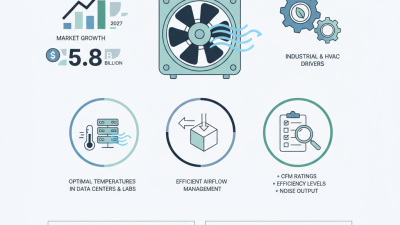
Choosing the right centrifugal fan is crucial for various industrial applications. According to a report by the Fan Manufacturers Association, the global market for centrifugal fans is expected to reach $4.2 billion by 2025, highlighting their importance in ventilation and air handling systems. Each application has unique requirements that influence fan selection, including airflow, pressure, and energy efficiency.
Dr. John Smith, a renowned expert in air movement technologies, states, “Selecting the appropriate centrifugal fan can significantly impact system performance and operational costs.” This emphasizes the need for careful consideration when choosing a fan. Many projects fail to meet performance expectations due to poor selection. A fan that is too small may not provide adequate airflow, while an oversized fan can lead to unnecessary energy consumption.
Understanding the specific needs of your application is vital. Factors such as noise levels, durability, and maintenance needs must be assessed. Reflections on past choices often reveal the importance of data-driven decisions in fan selection. Thus, a thorough evaluation process is essential for achieving optimal results in air management.

Understanding the Basics of Centrifugal Fans and Their Applications
Centrifugal fans play a vital role in various applications. They create airflow by converting rotational energy into air movement. Understanding their basics can guide you in selecting the right fan for your needs.
When considering centrifugal fans, think about your specific application. For example, some systems require high air pressure, while others focus on high airflow. Assess the environment where the fan will operate. Dust, moisture, or heat can influence performance dramatically.
Tips: Always check the fan's efficiency rating. An efficient fan consumes less power and lasts longer. Consider noise levels as well. Some applications might require quieter solutions.
Choosing the right material is crucial, too. Different materials handle temperature and corrosion differently. Reflect on these factors to avoid common pitfalls in selection. A poor choice can lead to increased maintenance costs and reduced performance.
Key Factors to Consider When Selecting a Centrifugal Fan
When selecting a centrifugal fan, various factors can significantly affect your decision. One vital aspect is airflow requirements. Many industry reports recommend analyzing airflow needs in cubic feet per minute (CFM). Higher CFM values mean greater air movement, crucial for ventilation. Additionally, consider the static pressure. The fan’s ability to overcome resistance from ductwork affects performance and efficiency.
A Delta-Q report indicates that optimizing static pressure can improve energy use by 20%.
The fan's operating environment is another key factor. Corrosive settings may require durable materials, while high-temperature areas need fans that operate efficiently under heat. Consult performance curves to match the fan's capabilities to your specific conditions.
Tips: Look for fans with adjustable speed settings. This feature offers flexibility for varying conditions. Also, consider the noise levels during operation. Some environments demand quieter solutions. A detailed analysis of noise ratings can guide your choice. Regular maintenance is essential for longevity, so factor in accessibility for repairs and check-ups. This can prevent potential downtimes in production.
Assessing Airflow Requirements and Performance Ratings
When choosing a centrifugal fan, understanding airflow requirements is crucial. This involves determining how much air volume your space needs. Airflow is typically measured in cubic feet per minute (CFM). For instance, if you're ventilating a small workshop, you might need around 500 CFM. A larger industrial setting may require several thousand CFM. Remember, estimating air requirements is not an exact science. It may take a few tests to find the perfect balance.
Performance ratings are also a key component of your decision. Look for efficiency ratings, as they inform you about the fan's energy consumption and overall effectiveness. You might encounter terms like static pressure and total pressure. Static pressure indicates resistance against airflow, while total pressure gives a broader picture of fan performance. It's essential to match these ratings to your specific application. However, some fans may outperform their ratings in real-world settings, while others fall short. Experimentation can be necessary to ensure optimal performance.
Evaluating Noise Levels and Energy Efficiency in Fan Selection
When selecting a centrifugal fan, evaluating noise levels and energy efficiency is crucial. Noise can greatly impact the working environment. A noisy fan may lead to discomfort for staff and decreased productivity. Different applications require varying noise levels. For instance, industrial settings may tolerate more noise than an office space.
Energy efficiency is another key factor in fan selection. An energy-efficient fan can lead to significant cost savings over time. Look for fans with high efficiency ratings, as they consume less power. It's also essential to consider the fan's operating conditions. The system's design and size can affect energy use and efficiency.
Understanding the balance between noise and efficiency can be challenging. Some fans operate quietly but may be less energy-efficient. Others may be powerful but noisy. It's important to analyze your needs carefully. Thoughtful consideration can yield better results in the long run. Always look for empirical data and usage scenarios to guide your choices. Be aware of potential compromises between quiet operation and energy consumption. Your ideal fan should reflect a balance tailored to your environment.
Comparing Different Types and Configurations of Centrifugal Fans
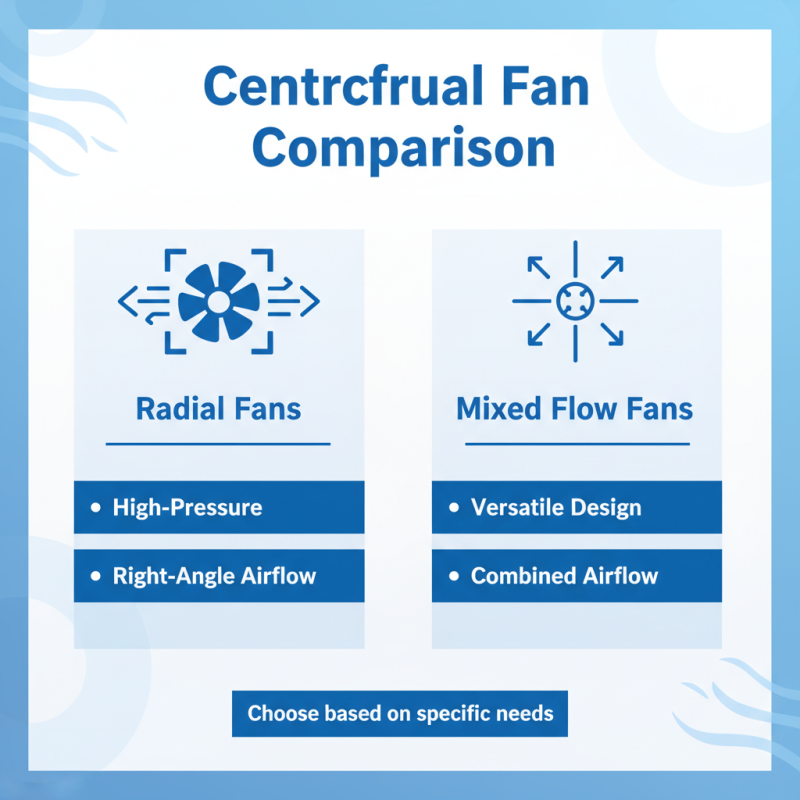
When selecting a centrifugal fan, it’s essential to compare different types and configurations. Centrifugal fans are categorized mainly into two types: radial and mixed flow. Radial fans push air out at a right angle, making them suitable for high-pressure applications. Mixed flow fans, on the other hand, combine axial and radial designs, offering versatility but may not be as efficient for specific needs.
Examining configurations is equally important. Fans can be open, closed, or semi-closed. Closed fans contain blades enclosed within a casing. They typically provide better performance and efficiency. However, maintenance can be challenging. Open fans allow for easier cleaning but might have lower efficiency. Each configuration comes with trade-offs, and users need to assess their situation carefully.
Energy efficiency is often a concern. Fans with variable speed drives allow adjustments based on demand. This can significantly reduce energy costs. However, initial investments might be higher. It's crucial to weigh operational costs against performance and efficiency. This decision is not straightforward and may require detailed analysis.